| |
|
|
 |
Did
you know that Nevada has over 400 hot springs? Did you know
that things can live in hot springs that are close to boiling? |
| Two
domains of microbes, bacteria and archaea,
are both impressive hot spring inhabitants. Thermophilic archaea are
probably the toughest organisms on
the planet when it comes to takin' the heat. They can live
in hot springs up to about 120 degrees Celcius (248 F)! Keep
reading for more information on these amazing Desert Survivors! |
|
|
|
|

 |
- Some
microbes can "eat" things like rocks, hydrogen gas, and
metal.
- In
addition to oxygen, microbes can "breathe" things like
carbon dioxide, metals, and salts.
- They
can live in some of the most exteme environments on Earth!
- Archaea
are the most thermophilic (heat loving) organisms known!
|
|
- The
hottest springs known are hydrothermal vents in the deep
sea. They can be up to 400 degrees Celsius (750 F).
- The
oldest microbial fossils are about 3.8 billion years
old!
- Some
scientists believe there to be microbial fossils on a
meteor
from Mars!
- Microbes can
be found almost everywhere on Earth. Some
places scientists have not yet found bacteria are
in
magma (hot
lava) and in some places in the Atacama
Desert of South America!
|
|
|
|
 |
- There
are about 200 species of bacteria in your mouth.
- There
are at least 457 hot springs in Nevada.
- 1,000
bacteria can fit on the tip of a pin.
- There
are more bacterial cells than human cells in your body.
- Your
skin contains about 1 trillion bacterial cells.
- Bacteria were
first discovered in the 1670s, along with rotifers,
by van
Leeuwenhoek.
- There
are more microbes on your hand than there are people on the planet.
- Bacteria are used to make soy sauce, yogurt, saurkraut, vinegar, soda,
cheese, infant formula, gum, paper, and even laundry detergent!
- It
is thought that if you could weigh all the living things on
Earth, bacteria would make-up ½ of
the total weight.
|
|
 |
 |
Size:
We are usually SUPER tiny. 500 to 1,000 average bacteria can
fit on the tip if a pin! We are usually only visible when
we are in large groups or colonies or under a microscope.
However, there is actually a described
bacterium that is
as big as the period at the end of this sentence.
Color:
We can be all different colors, but most of the colors
you see in pictures of us are from special dyes and stains
used by researchers to see us better and distinguish different
kinds of microbes. |
|
 |
 |
- Bacterial
cells can be spherical, rod shaped, or spiral
shaped.
- Rods
= bacilli (singular form is bacillus)
- Spirals
= spirilla (singular form is spirillum)
- Spheres
= cocci (singlular form is coccus)
|
|
|
|
|
 |
 |
Microbes can
thrive at temperatures where plants and animals cannot survive.
In fact, thermophilic archaea are
the only things that can live near 120 degrees Celcius (248
F, THAT'S HOTTER THAN BOILING WATER!). As water from hot
spring sources flows away, it cools down, which makes it
more attractive to some other kinds of organisms.
|
Algae
of many different types can share some of the warm
springs with bacteria.
For the most part, microbes that
live in hot springs have few if any competition or predators!
Many
hot springs are dangerous as a result of not only their
high temperature, but also because they have varying
levels of chemicals that are harmful to many organisms
such as high levels of sulfide. |

|
|
 |
Hot
springs have become a common recreational destination for vacationers.
Some springs have been tested and manipulated to be safe for
swimming and soaking. Look
into some of these locations and
perhaps visit some of these locations with your family but
be aware of the rules for the area and be careful around hot
springs. Many of them are too hot for our bodies to survive
and some have harmful chemicals. |
|
|
 |
Can
you believe that some microbes actually
eat rocks/minerals!? These thermophilic archaea are
considered "autotrophic".
You are probably familiar with plants being autotrophic,
as they use carbon dioxide from the air and the energy from the
sun.
Microbes can be
photosynthetic like plants, in the case of cyanobacteria and algae,
but they can also be "lithoautotrophs" or "chemoautotrophs",
which obtain energy directly from chemicals in the spring. Simply
put, they use energy that is already stored in the chemical bonds
of compounds. By oxidizing the
compounds, the energy stored in the bonds can be used by the bacteria.
Some
of the inorganic compounds
used by lithoautotrophs are
ferrous iron and sulfur. You are actually considered a chemoheterotroph,
as you get both energy and carbon from chemicals you eat (AKA FOOD!). |
|
 |
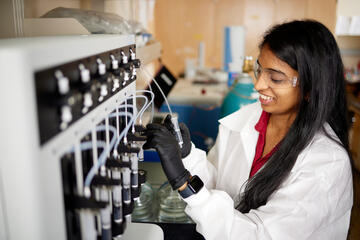
Very...
very... carefully! The water is often tested for mineral
content and other compounds, temperature and characteristics
like pH. The organisms in the springs are collected
and brought back to the laboratory for analysis.
Here,
these researchers are using an instrument called a bubble
stripper that replaces gases in a water sample with nitrogen
and then allows the scientists to test the gas that comes
out of the water and evaluate its component gases. |

Dr.
Chris Romanek, Adam Socki, Hayley McLeod sample gases in Washoe
County, Nevada. |
Many
different kinds of scientists work together to learn more
about hot springs and their inhabitants:
Every
research topic often has many different aspects
that are investigated by all sorts of different kinds of
researchers. Researchers may be of different ages, genders, cultural
and ethnic backgrounds, and they even specialize in different
scientific fields. You can be a researcher too!
|
|
|
 |
1.
How many bacteria do you think could fit on the tip of a pin? About
500 to 1000!!!
2.
What shapes do bacteria come in? Rods call bacilli - Spheres
called cocci - Spirals called spirilla.
3.
Can anything live in 120 degree Celsius water? YES! Thermophilic
archaea!
4.
How many hotsprings are in Nevada? Over 457! |
|
 |

|
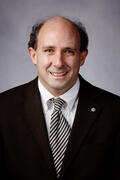
Dr.
Brian Hedlund is an assistant professor at the University of Nevada,
Las Vegas. He received his Ph.D. from the University of Washington
and started his research on hot springs at the University of Regensburg
in Germany. His research centers around microbial life in hotsprings.
One of the main goals of his research is to learn which chemicals
support chemolithotrophic life in different kinds of hot springs.
|
| Tune
in to Episode Two to find out more about what makes these desert
organisms so special! Episode Two highlights hot springs of Nevada
and their microbial inhabitants! |
|
 |
| Stalking
the Mysterious Microbe - for great experiment ideas! |
| The
Microbe Zoo - for info about different microbial habitats. |
| Living
Bacteria Through the Microscope - for awesome bacteria pics! |
|
|
|