College of Sciences E-newsletter

April 2007

In this issue:

Back to E-Newsletter Directory


Dr. Carl Reiber to serve as Associate Dean for Academic Affairs in the College of Sciences effective July 1, 2007

Dr. Carl Reiber will serve as Associate Dean for Academic Affairs in the College of Sciences effective July 1, 2007. In recommending the appointment to President David B. Ashley, Michael Bowers and Dawn Neuman, Co-Officers In Charge, noted that Reiber will take the lead in the development of a new scholars program for the college, in an attempt to recruit under represented minorities into the STEM (Science, Technology, Engineering, and Mathematics) disciplines, and also work with College of Sciences, College of Engineering, and College of Education colleagues on the development of a School of Science and Math Education proposal.

Back to Top


Jennifer Utz, Ph.D. Candidate Receives National Science Foundation (NSF) Graduate Research Fellowship

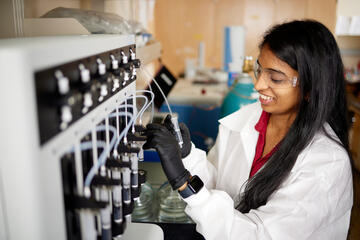
Jenifer Utz, a doctoral candidate in the School of Life Sciences is the recipient of a three-year National Science Foundation (NSF) Graduate Research Fellowship. The program recognizes and supports outstanding graduate students in the relevant science, technology, engineering, and mathematics (STEM) disciplines who are pursuing research-based masters and doctoral degrees. NSF Fellows are expected to become knowledge experts who can contribute significantly to research, teaching, and innovations in science and engineering. These individuals will be crucial to maintaining and advancing the nation's technological infrastructure and national security as well as contributing to the economic well being of society at large. Dean of the College of Sciences Ron Yasbin commented, "This support from NSF recognizes Jenifer's outstanding work and her potential for even greater accomplishments."

The NSF Fellowship provides a stipend of $30,000 per year and an education allowance of $10,500 per year to support her advanced studies. Jenifer currently works in the laboratory of assistant professor Frank van Breukelen, who noted, “Jenifer has earned this recognition through her tireless research and study on the control of protein synthesis during mammalian hibernation.” Carl Reiber, Director of the School of Life Sciences observed, "Jenifer’s contributions to our university and school set a new standard for our graduate students. We are proud and privileged to work with students of this caliber."

Funding from NSF is crucial to research faculty and students alike, and UNLV scientists compete successfully with peers across the nation for federal grants. For Jenifer, this support translates to a much different graduate student experience, "With an NSF Graduate Fellowship I will be able to focus on my research yet also integrate important teaching and outreach activities. My dissertation program is ambitious. The concentrated timetable that accompanies this fellowship means I will be able to make rapid progress in achieving my research goals. As this award indicates, my success as a research scientist will depend on both my productivity and ability to successfully compete for external funding. I am honored by the professional recognition that this fellowship represents, and I am excited about the new opportunities it provides."

Hibernation in mammals presents extreme physiological challenges at both the subcellular and whole organismal levels. The principal focus of Jenifer's research is the hibernation of golden-mantled ground squirrels (Spermophilus lateralis). Hibernation is not static. Rather, the animals experience 1-3 week torpor (a manner of reducing metabolism to reduce energy) cycles that are repeated throughout a six to nine month hibernation season. During torpor, entire organ systems are turned off. Yet, in an almost magical way, these animals spontaneously arouse and resume normal physiological function. Jenifer will investigate how these animals survive severe physiological shifts - hibernating mammals experience metabolic rates that may be as low as 1% of active rates and core body temperatures as low as -2° C - and illuminate the potential roles for both passive temperature effects and active regulatory mechanisms in controlling protein synthesis during hibernation.

Jenifer’s research opens many possibilities for improving the human condition. As a result of her research we may gain valuable insights as to how hibernators survive conditions that would be deadly to other mammals, including humans. Understanding the mechanisms of hibernation could impact human medical practices regarding pathologies such as disuse atrophy (muscle wasting caused by immobilization), hypothermia, ischemia, obesity, and diabetes.

Back to Top


National Institute of (NIH) Grant Awarded to Assistant Professor Eduardo Robleto, “Role of Transcription in Adaptive Mutagenesis ($222,000)

Assistant Professor Eduardo Robleto, School of Life Sciences, and Professor Ronald Yasbin, College of Sciences, have received a three year grant from the National Institute of Health (NIH) for a research project to understand, at the molecular level, new processes that generate mutations when cells are in stress conditions. Such mechanisms have the potential to influence processes as diverse as evolution, the development of cancer, and how pathogens overcome host responses and antibiotic therapy. In addition, Robleto’s laboratory research focuses on two areas of research within the fields of microbial ecology and microbial genetics.

The main goal in this proposal is to characterize, at the molecular level, novel cellular mechanisms that generate mutant proteins as part of the stress-induced increase in genetic diversity. Such mechanisms have the potential for influencing processes as diverse as evolution and the development of neoplasms (new abnormal growth of tissues; malignant neoplasms show a greater degree of anaplasia and have the properties of invasion and metastasis, as compared to benign neoplasms).

Bacillus subitlis provides a readily accessible paradigm for the study of formation of mutant transcripts, the control of cell differentiation and stress induced mutagenesis. The specific hypothesis in this research is that the mfd gene in Bacillus subtilis contributes to the generation of mutated transcripts in non-growing cells.  It is speculated that Mfd, a factor involved in repair of transcribed DNA, mediates the generation of mutations by increasing transcription and allowing the formation of mutated transcripts in the presence of DNA lesions. This project will investigate the effects of mfd on transcription in Bacillus subtilis.

Back to Top


2nd Annual Geoscience Student Symposium, April 20-21, 2007

The Geoscience Department is planning its 2nd Annual Geoscience Student Symposium. The symposium is student-run and it is designed to provide graduate and undergraduate students with an opportunity to present their original research and receive feedback from industry, civic, and government professionals as well as academic experts. UNLV Geoscience students are planning a two-day event including presentations on Friday April 20th (Barrick Museum) and field trips on Earth Day, Saturday April 21st. Oral presentations will be offered on Friday morning, and the 15 minute sessions will include time for discussion with audience members. Lunch will follow the oral presentations, with poster sessions scheduled for the afternoon period. A review panel will award prizes for the best presentations and posters in several geoscience specialties. The day will conclude with a post-symposium gathering of all students, faculty, and invited guests at a reception with food and refreshments. Half-day field trips are scheduled for Saturday, one in the morning and another in the afternoon. The field trips will focus on the geology of the Lake Mead area. Interested participants will tour Lake Mead on a houseboat, the Forever EarthTM, in the company of experts on the surrounding geology of this unique region.

The UNLV Geoscience Student Symposium will showcase a wide range of important graduate and undergraduateresearch and provide a forum for participating students to develop presentation skills in a friendly, relaxed environment. Student research projects include such diverse topics as: soils, geomorphology, hydrogeology, paleontology, sedimentology, stratigraphy, geochemistry, volcanology, seismology, structural geology, and economic geology. In 2006, more than 30 UNLV Geoscience students presented their research. The 2007 Symposium will continue this dynamic and rewarding annual tradition


Back to Top


New GIS (Geographic Information Systems) Web Design, and Graphics, Specialist, Rebecca Huntoon joins the Geoscience Department and the College of Sciences

Rebecca "Becki" Huntoon has joined the Geoscience Department and the College of Sciences to provide staff support for faculty and students who need GIS services, web design needs, and graphics assistance. GIS services include analysis that combines relational databases with spatial interpretation and outputs often in form of maps. In addition, Becki can assist with the use of computer programs for capturing, storing, checking, integrating, analyzing and displaying data about the earth that is spatially referenced. Becki is a recent graduate of California State University, Chico with a degree in Human Geography and a certificate in GIS Technologies.

Becki would like her colleagues to know that she can assist with the updating and maintenance of departmental and faculty websites throughout the College of Sciences, and she will endeavor to provide support in terms of any graphics needs for assignments, research, presentations, and publications.  Her knowledge and skills in the areas of cartography and remote sensing and her knowledge of data analysis can produce and map output that is both aesthetically pleasing and cartographically correct. 

Contact Information: Rebecca Huntoon, Web, Graphics, and GIS Specialist, Geoscience Department, University of Nevada, Las Vegas, 4505 Maryland Parkway, Las Vegas, NV  89154-4010. Office: TEC 102; 702-895-5387; rebecca.huntoon@unlv.edu

Back to Top


"A Personal View: Desert Survivors: the Design and Implementation of a Television Program to Enhance Local Scientific Literacy," by Jenifer C. Utz1, Candice M. Rausch, Laurie Fruth, Megan E. Thomas and Frank van Breukelen , Advan. Physiol. Edu. 31: 1-4, 2007;

Abstract: Outreach efforts by faculty members are oftentimes limited in scope due to hectic schedules. We developed a program to enhance science literacy in elementary school children that allows experts to reach a tremendous audience while minimizing their time commitment. The foundation of the program is a television series entitled "Desert Survivors." The episodes air on local cable access television and are available to teachers on DVD. Each episode features a guest expert who spotlights a particular organism and how that organism overcomes the myriad of hardships inherent to desert survival. Local classrooms are visited to solicit questions from students regarding the organism of interest. These videotaped questions are integrated into Desert Survivors television production and provide the guest expert with the basis to discuss the ecology, physiology, and evolutionary biology of the organism. The program is bolstered through the use of an interactive website. Assessment strategies are in place to ensure program efficacy. Herein, we describe the development of the program as a model for innovative outreach opportunities.

Back to Top


Faculty Member Joins Editorial Board of Plant Science: An International Journal of Plant Science

Jeffrey Shen, associate professor, School of Life Sciences has joined the editorial board of Plant Science:  An International Journal of Plant Science, for a three year term, 2007-2010.

Back to Top


UNLV Sponsors Math Camps

The University of Nevada, Las Vegas is presenting a free information series on its middle school and high school summer space math camps. The session was held from 7 to 9:30 p.m. March 22 at UNLV's Paradise Campus, 851 E. Tropicana Avenue. Dieudonne Phanord, director of UNLV's Center for Atmospheric, Oceanic and Space Sciences, will explain the purpose and content of the university's space-related summer math camps scheduled in June. Students entering grades six through 11 in the fall of 2007 may attend the camps. Incoming high school seniors with a serious interest in a space-related math and space career also may find the information session beneficial. Students and parents will learn about camp fees, university summer housing and dining facilities to be used during the camp, a planned field trip to the Jet Propulsion Laboratory in Pasadena, Calif., and UNLV's National Youth Summer Sports program, in which the math camp students also will participate during the weeklong camp. The space math camps are scheduled from June 18-23 and June 25-29, To register, call 895-3394.

Back to Top


Revised Web Pages: Undergraduate Advising Center and Water Resources Management Program

The College of Sciences launched revised web pages for the Undergraduate Advising Center and the Water Resources Management Program. Both sites include enhanced information about academic programs and requirements.

Back to Top


"Soils Risks and Hazards," Natural Resources Conservation Center

The 2007 Soils Planner highlights twelve research projects that enhance our understanding of soils and provide important information to protect humans and other life forms. Associate Professor of geoscience Brenda Buck’s research on chemical heave and expansive salts in western and southwestern deserts is among the featured projects.

Back to Top


2007 BIOS Distinguished Lecture

The School of Life Sciences Graduate Student Organization (BIOS) presented the sixth annual BIOS distinguished lecture on Friday, March 23, 2007, 3:30 P.M., in the White Hall Auditorium. The 2007 BIOS Distinguished Lecturer is Dr. Peter Kareiva of  the Nature Conservancy. Kareiva's past publications and research have concerned such diverse fields as mathematical biology, fisheries science, insect ecology, landscape ecology, risk analysis, conservation, and global climate change. The title of his lecture was, "Responding to Conservation's Biggest Challenges: Global Change and Global Indifference."

Back to Top


School of Life Sciences Seminar

On Friday March 30, 2007, Everett Shock, professor in the School of Earth and Space Exploration and the Department of Chemistry at Arizona State University presented a seminar entitled "Biogeochemistry of Hot Spring Ecosystems at Yellowstone National Park," in the White Hall Auditorium at 3:30 pm. Shock is the Director of the Keck Foundation Lab for Environmental Biogeochemistry at ASU. His interdisciplinary interests range from theoretical and empirical thermodynamics, to geochemistry, to environmental microbiology, to astrobiology and has resulted in approximately 100 publications in the primary literature, including several papers in Science and Nature.

Back to Top


Upcoming Seminars

The College of Sciences has established a listserve to better publicize and promote scientific seminars offered throughout the academic year. For more information on upcoming seminars and to subscribe to the listserve, please visit: http://cmse.unlv.edu/seminar/.

Back to Top


Submit Your News Stories

The College of Sciences E-Newsletter is published on or about the first of each month. Please submit news items via email by the fifteenth of each month, for consideration. You may send your submissions to: Bill Brown, Director of Development william.brown@unlv.edu.

Back to Top


Related Links


Get Adobe Reader