College of Sciences E-newsletter

January 2007

In this issue:

Back to E-Newsletter Directory


Stanley D. Smith, UNLV professor in the School of Life Sciences, Appointed Interim Associate Vice President for Research Services, effective January 1, 2007

Ron Smith, Interim Vice President for Research and Graduate Dean announce that Dr. Stanley D. Smith, UNLV professor in the School of Life Sciences, has been appointed as Interim Associate Vice President for Research Services, effective January 1, 2007. Stan Smith joined UNLV in 1985 and has since been the recipient of many prestigious awards, including the 2006 Barrick Distinguished Scholar Award, 2003 Harry Reid Silver State Research Award, and 1997 Regents Outstanding Faculty Award. His primary research interests include global change, desert ecology, and plant physiological ecology. He has been successful in receiving EPSCoR and national peer-reviewed grants and is very familiar with the research challenges facing our campus. In his letter of interest for the position, he promised hard work to improve our research infrastructure, attention to detail, and willingness to work with researchers across the campus to advance the research reputation of the university.

Back to Top


Physics and Astronomy Department Celebrates Name Change

The NSHE Academic Affairs Council approved the following name change at their November 2006 meeting. The Department of Physics is renamed the Department of Physics and Astronomy, effective 1 January 2007. Dean Yasbin wishes to congratulate our colleagues on their success and on their initiatives. In 2006 UNLV saw both the approval of the graduate programs in Astronomy and now this formal name change. All of the faculty in department have worked together to strengthen areas of expertise in physics, astronomy, and astrophysics. A special congratulations needs to go out to professor emeritus Donna Weistrop (now retired and living in Flagstaff) for her determination and leadership as well as to Steve Lepp and Jim Selser for never giving up on these initiatives.

Back to Top


Doctoral Student Among Winter 2006 Commencement Outstanding Graduates

Zhen Xie, Ph.D., Biology, is the first UNLV student to be accepted by Harvard University as a postdoctoral fellow. He is currently working at the FAS Center for Systems Biology at Harvard University, where he is investigating molecular automate, which could aid in diagnosing and treating diseases at the cellular level. As a student, Mr. Xie also received a fellowship from the Institute of Genome Research, an international leader of genome research.

Back to Top


Primus Corporation Donates HLPC Analyzer Systems

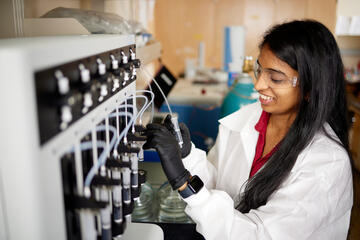
Primus Corporation recently donated four High Performance Liquid Chromatography (HPLC) Analyzer Systems to UNLV, for use by undergraduate and graduate students. Two units are housed in the Chemistry Building. This equipment will help students gain familiarity with the principals of HPLC for chemical separations. Primus Corporation provides accurate and precise analytical systems to the medical community for diagnosing and monitoring patient health through products and services of the highest standards. A leader in in-vitro diagnostic testing, Primus provides laboratories around the world with innovative approaches to clinical diagnostic testing. Special thanks are owed to Thomas J. Reidy and Jon Davis, (Chemistry, B.S., 1993) for this donation and the installation of the units in the Chemistry Building.

Back to Top


Astrophysics Faculty Members Receive Funds

The National Aeronautics and Space Administration (NASA) recently funded two proposals ($60,000; one proposal received full funding, a second received partial funding) from assistant professor Bing Zhang. This funding, approved for the third consecutive year, will support Zhang and his group's research efforts relating to the Swift Mission, Swift is a first-of-its-kind multi-wavelength observatory dedicated to the study of gamma-ray burst (GRB) science. Its three instruments will work together to observe GRBs and afterglows in the gamma ray, X-ray, ultraviolet, and optical wavebands.

Assistant professor Daniel Proga has received funding from the Chandra X-Ray Center, a NASA-operated facility in Cambridge, Massachusetts. Proga's research proposal includes efforts to study the center of the Milky Way, including its supermassive black hole. NASA's Chandra X-ray Observatory, which was launched and deployed by Space Shuttle Columbia on July 23, 1999, is the most sophisticated X-ray observatory built to date. Chandra is designed to observe X-rays from high-energy regions of the universe, such as the remnants of exploded stars.

Back to Top


Innovation: The Research Journal of the University of Nevada, Las Vegas

The new issue of Innovation: The Research Journal of the University of Nevada, Las Vegas is now available in print and electronic format. One of the featured articles, "The Hydrogen Equation," focuses on UNLV science and engineering researchers who are leading the effort to make the use of hydrogen fuel environmentally friendly, safe, and cost-effective. The cover photograph features our own Professor Clemens Heske. This issue also features a status report on the Science and Engineering Building (SEB), scheduled to complete construction in 2008. In a summary report on external funding for FY 2006, the College of Sciences is recognized for receiving $ 19.9 million from a variety of federal agencies — first among UNLV programs.

Back to Top


Stockpile Science Graduate Fellowship Program

The Stockpile Science Graduate Fellowship Program provides tuition, fees and $32,000 per year to a graduate student pursuing a Ph.D. in disciplines related to stockpile science. Two or three awards are anticipated in Spring 2007 for a student beginning his/her studies in Fall 2007. In 2006 the number of applications in materials science, plasmas, and dynamics was limited; other fields were well represented. The application deadline is 20 February 2007. For more information please visit: http://www.krellinst.org/ssgf/.

Back to Top


Kavli Chinese-American Frontiers of Science

Cathy Snelson, assistant professor of Geoscience, was an invited participant at the recent Kavli Chinese-American Frontiers of Science Meeting. This gathering of leading international scientists offered a series of multidisciplinary presentations ranging from nano-technology to black holes. Sandra Saldana an undergraduate student, majoring in physics, and who works with Snelson, also attended the meeting. Saldana was selected as the outstanding undergraduate student researcher in the Nevada National Science Foundation (NSF) EPSCoR Program in 2006 and represented Nevada and the National EPSCoR meeting in Kentucky. Sandra was one of only two undergraduate students who made research presentations at this meeting; the other student presenters were master's and doctoral students.

Back to Top


"Cheaters Never Prosper," ASU Web Devil, November 30, 2006

Dean Ron Yasbin was among those interviewed for this article on student cheating.

"With the Internet, BlackBerrys and cell phones, all kinds of information is available at the push of a button - even answers to a difficult test. Welcome to a new age of academic dishonesty: the high-tech age. Students have new methods of cheating that they didn't have just a few years ago: Web sites, cell phones, two-way pagers and PDAs. Even iPods with wireless headsets can be used for dishonest purposes. Whatever high-tech medium students choose, it sure beats writing the answers on the back of their hands."

"[Cheating] is a real problem [at ASU]," says Barbara Colby, director of academic affairs at the College of Liberal Arts and Sciences. "I think it is because students have such easy access to the Internet," she says. "It's on their desk right in front of them."

"…A New York Times article discussed this growing problem last May, reporting instances of high-tech cheating at San Jose State University, the University of California at Los Angeles and the University of Nevada at Las Vegas…Ron Yasbin, dean of the College of Sciences at UNLV, says many students think it's OK to use technology to get answers. "For these students - and they are not a majority - every new gadget is another way to get better grades," he says.

Read the full text.

Back to Top


Spring 2007 Book List

A partial list of the course readings for College of Sciences Spring 2007 classes is available on line to assist students in acquiring these textbooks and other materials in advance of the start of classes.

Download the book list. (PDF)

Back to Top


Physics Forum

On Friday, December 8th Dr. Phil Armitage from the Joint Institute for Laboratory Astrophysics (JILA) and The University of Colorado, Boulder, delivered a presentation on new insights into the solar system from extrasolar planets.

Abstract: The discovery of 200 extrasolar planets provides a statistical sample of planetary systems to compare with our own Solar System. Some properties of extrasolar planetary systems - such as the existence of some gas giants with day-long orbital periods, and others with orbits as eccentric as comets - are alien enough that we may question whether the Solar System is a typical or rare outcome of the planet formation process. I will discuss recent observations of massive extrasolar planets, their implications for theories of giant planet formation, and more speculative consequences for the abundance of habitable planets.

Back to Top


Upcoming Seminars

The College of Sciences has established a listserve to better publicize and promote scientific seminars offered throughout the academic year. For more information on upcoming seminars and to subscribe to the listserve, please visit: http://cmse.unlv.edu/seminar/.

Back to Top


Submit Your News Stories

The College of Sciences E-Newsletter is published on or about the first of each month. Please submit news items via email by the fifteenth of each month, for consideration. You may send your submissions to: Bill Brown, Director of Development william.brown@unlv.edu.

Back to Top


Related Links


Get Adobe Reader