College of Sciences E-newsletter

March 2007

In this issue:

Back to E-Newsletter Directory


Professor Jean Cline Receives National Science Foundation Grant, “Collaborative Research on Fluid Pathways, and Metal Transport and Deposition in Carlin-Type Gold Deposits: Insights From the Getchell System,” ($295,868)

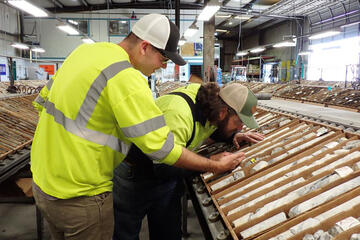
This collaborative study by researchers at the University of Nevada, Las Vegas ($295,868) and the University of Nevada, Reno ($162,544) aims to develop a time-space geological and geochemical framework of the classic Carlin-type gold deposits of the Getchell district in northern Nevada by utilizing data from more than 12,000 holes drilled by mining companies and sophisticated 3D modeling software to identify samples for state-of-the art in situ micro analytical techniques. This project is another is a series of collaborative geoscience research efforts among faculty at these institutions.

With the drill holes and modeling software we will build a comprehensive 3-dimensional model from which we will interpret fluid pathways taken by the gold-bearing hydrothermal fluids. We will then add the fourth dimension, time, to the model by integrating detailed micro analytical studies of various stages of quartz, pyrite, and other sulfide minerals at locations along interpreted fluid pathways. Specifically, the investigators will document how the textures and isotopic and trace element compositions of quartz and pyrite vary with time and at any given point in space, using cathodoluminescence, electron microprobe chemical analyses, laser ablation ICP-MS chemical analyses, and in situ ion probe isotope analyses. The isotopic and trace element composition of the quartz and pyrite are essentially fingerprints of the hydrothermal fluid and analyses of various minerals will allow better tracking of the passage and evolution of the ore fluid. By comparing these "fingerprints" in different samples from different locations along fluid pathways it will be possible to deduce how the composition of the hydrothermal fluid, which formed the gold-bearing pyrite and quartz, varied both in time and space. It is also planned to study samples of the hydrothermal fluid trapped as fluid inclusions in the quartz to deduce how temperatures and compositions of the ore-forming fluid varied in time and space along fluid pathways. From these data the investigators will be able to constrain depositional mechanisms in high-grade portions of the ore bodies by identifying how fluids physically and chemically evolved as they traveled into, through, and out of high-grade ore zones.

Carlin-type gold deposits in Nevada account for about 8% of the annual worldwide gold production, making the United States the second largest gold producer in the world. Despite their importance, several aspects of their origin remain enigmatic. The results of this research will not only lead to better understanding of the origin of Carlin-type deposits, but will also lend insights into broader earth processes. This project will advance our understanding of hydrology and mass transfer involved with hydrothermal circulation in upper crustal rocks that were being heated and extended. Important new knowledge will be generated through a research partnership between the mining industry, Nevada's second most important industry, and the researchers, including a post doctoral fellow and graduate and undergraduate students. This knowledge will improve exploration for similar gold deposits in Nevada and other parts of the world. Project results will also contribute to mineral potential assessment by government agencies and mining companies, and improved land use decisions by government agencies.

Back to Top


New Investigator Award (NIA) for assistant professors Kentaro Nagamine and Janelle Bailey

"Implementing Learner-Centered Strategies in Introductory Astronomy Courses: A Case Study of a New Professor," is a joint effort between assistant professor Janelle Bailey (PI, College of Education, Curriculum & Instruction) and assistant professor Kentaro Nagamine (Co-PI, College of Sciences, Physics and Astronomy). The goal of the project is to study how a new professor (in this case, Kentaro Nagamine) will learn about and implement learner-centered teaching strategies in his introductory astronomy course. Traditionally, astronomy is taught by lecture in large, auditorium-style classrooms, where students passively listen to someone talking about the wonders of our universe. After attending a NASA-sponsored workshop in May 2007, Nagamine will revise his course to involve students in small-group and large-group activities that help students become more active learners, discussing complex ideas with their peers in order to reinforce their understanding of astronomy. Bailey will serve as a mentor to Nagamine, as he decides what types of activities to use in his course. She will also study his decision-making process and identify barriers or problems that might exist in implementing the new strategies. These results will help improve future offerings of the NASA-sponsored workshops and similar meetings for astronomy faculty nationwide. The NASA workshop is directed by faculty from the University of Arizona, where such learner-centered strategies have helped thousands of students improve their understanding of astronomy in recent years.


Back to Top


"Opening the Door to Volcano’s Core: UNLV Professor to Join Pioneering Drill Team at Russian Site," by Lawrence Mower, Las Vegas Review Journal, February 26, 2007

Adam Simon, assistant professor in the geoscience department, recently discussed his research on volcanoes and geo-thermal energy in an article published in the Las Vegas Review Journal.

"The location could be described as a sort of hell. Plants don't grow there. Steam at 1,100 degrees Fahrenheit spews from the surface, sprinkling toxic minerals over the ground. One false step could lead you to careen down into the green lake hundreds of feet below, which has water "like battery acid." If those things weren't bad enough, consider that you're on top of the Mutnovsky volcano, which last erupted in 2000, in the Kamchatka peninsula of Russia -- a region with the highest concentration of active volcanoes anywhere in the world. For UNLV assistant professor and geologist Adam Simon, a trip to Kamchatka, in the far eastern corner of Russia, is a golden opportunity -- "the mother lode" of volcanic activity on Earth, he says… Simon believes his experience and the research will yield valuable information about what causes volcanoes to erupt and how magma heats underground water. Between 2 percent and 3 percent of Nevada's power is generated through geothermal power, he said, making the state second in the nation behind California in geothermal energy produced. Nevada has no active volcanoes but large amounts of geothermal activity -- enough to supply power to between 2 million and 3 million people, Simon said.

Full text article.

Back to Top


Faculty Publication: Bodner, G. M., & Orgill, M. (Eds.). (2007). Theoretical Frameworks for Research in Chemistry/Science Education. Upper Saddle River, NJ: Pearson Education Publishing

MaryKay Orgil (UNLV) and George Bodner (Purdue University) are pleased to announce the publication of Theoretical Frameworks for Research in Chemistry/Science Education, the most recent addition to the Prentice Hall Series in Educational Innovation.  

Selected Text from the Prologue

For qualitative research studies in education, the theoretical framework plays a role analogous to the role of the instrument. A theoretical framework is a system of ideas, aims, goals, theories, and assumptions about knowledge; about how research should be carried out; and about how research should be reported that influences what kind of experiments can be carried out and the type of data that result from these experiments. According to Crotty (1998), a theoretical framework is “the philosophical stance informing the methodology and thus providing a context for the process and grounding its logic and criteria” (p. 3). Because a theoretical framework has great influence on the design, data collection, and data analysis of qualitative studies, each qualitative researcher must make explicit the framework he or she has chosen for a particular study…

…We have, therefore, tried to create a concise volume in which various theoretical frameworks used in chemistry education/science education research are described and critiqued. In this book, we will also review and discuss the potential applications of each theoretical framework to different types of chemistry education/science education research. Our goal is to help practicing chemists, chemistry instructors, and chemistry educators learn how to do basic educational research within the context of their own instructional laboratories and classrooms…

…This book is an outgrowth of a series of discussions with graduate students and faculty from departments of chemistry, schools of education, and, more recently, colleges of engineering, that inevitably seemed to focus on the question: Where can I obtain the information that would enable me to make an intelligent choice about the theoretical perspective or framework upon which I can build the study I want to carry out?...

…The goal of this book is to help those who want to learn how to design educational research studies that are consistent with the call for rigorous research issued by the National Research Council Committee on Scientific Principles for Education Research (Shavelson & Towne, 2002). The NRC report argued that scientific research in education poses a significant question that can be investigated empirically; that this research is linked to relevant theory; and that it uses methods that permit direct investigation of the question. It called for research that provides a coherent, explicit chain of reasoning; can be replicated/generalized across studies; and is subject to professional scrutiny and critique. Research of this nature should also meet the criteria set forth by Diamond (2002), who calls for research that requires a high level of discipline-related expertise; that is conducted in a scholarly manner with clear goals, adequate preparation, and appropriate methodology; that has significance beyond the setting in which the research is conducted; that is innovative; that can be replicated or elaborated on; that is appropriately and effectively documented, including a thorough description of the research process and detailed summaries of the outcomes and their significance; and is judged to be meritorious and significant by a rigorous peer review process.

References

Crotty, M. (1998). The Foundations of Social Research: Meaning and Perspective in the Research Process. Thousand Oaks, CA: Sage Publications.

Diamond, R. (2002). The Mission-Driven Faculty Reward System. In R. M. Diamond (Ed.), Field Guide to Academic Leadership (pp. 271-292). San Francisco, CA: Jossey-Bass.

Shavelson, R. J., & Towne, L. (2002). Scientific Research in Education. Washington, DC: Committee on Scientific Principles for Education Research, National Research Council.


Back to Top


Science Bowl 2007

Thirty-two teams from high schools in Arizona, California, Nevada, and Utah competed in the sixteenth Annual Nevada Regional Science Bowl, February 9-10, 2007, at the University of Nevada, Las Vegas. The winning team will travel to Maryland to compete with high schools across the country. The U.S. Department of Energy's National Science Bowl, which will be held April 26-30, 2007 in Chevy Chase, Maryland, is a highly publicized academic competition among teams of high school students who are quizzed on scientific topics in astronomy, biology, chemistry, earth science, general science, mathematics, and physics. The objective of the Science Bowl is to promote and challenge the nation’s high school students to excel in math and science. The competition consists of a round robin followed by a double elimination final. Questions are submitted by scientists at all of Department of Energy's facilities as well as from other federal agencies and university consortia. Each Science Bowl team is composed of four students, one alternate student, and a teacher who serves as an advisor and coach. More than 100,000 students have competed in the Science Bowl since its establishment in 1991.

Roy D. Bridges, Jr., a former NASA astronaut, and pilot of the Space Shuttle Challenger on mission STS-51-F from July 29 to August 6 1985, served as the keynote speaker at the luncheon. “Getting to be a part of the space shuttle program as an astronaut was another highlight, of course. I flew on the Challenger for eight days and 126 orbits around the earth. That experience was just awesome. I was preparing to fly again on the Challenger when the accident happened in 1986. It was a very heartfelt tragedy, and it changed all of our lives.” said Bridges. Nate Tannenbaum served as master of ceremonies and moderated the final round of competition.

This year's schools include:

Nevada:

Las Vegas: Advanced Technologies Academy (2 teams), Bonanza High School, Centennial High, School, Cheyenne High School (2 teams), Clark High School (2 teams), Durango High School, Faith Lutheran High School (2 teams), Foothill High School, Palo Verde High School, Shadow Ridge, High School (2 teams), Valley High School (2 teams).

Reno: Bishop Manogue High School, Procter Hug High School, Reno High School (2 teams), Wooster High School.

Henderson: Green Valley High School.

Boulder City: Boulder City High School (2 teams).

Minden: Douglas High School.

Fallon: Churchill County High School.

Sparks: Spanish Springs High School.

Zephyr Cove: Whittell High School.

Utah:

Cedar City: Canyon View High School, Cedar City High School.

California:

Big Pine: Big Pine High School.

Science Bowl sponsors: Atomic Testing Museum; Bechtel SAIC Company, LLC; U.S. Bureau of Reclamation, Regional Office & Hoover Dam; Desert Research Institute; National Security Technologies, LLC (NSTec); Northrop Grumman; Stoller-Navarro Joint Venture; University of Nevada, Las Vegas; U.S. Department of Energy National Nuclear Security Administration Nevada Site Office; U.S. Department of Energy, Office of Repository Development; and Wackenhut Services, Inc.

Back to Top


Beal Bank of Nevada Southern Nevada Regional Science and Engineering Fair

The Beal Bank of Nevada Southern Nevada Regional Science and Engineering Fair promotes an interest in mathematics and scientific studies for students in the Clark County School District (CCSD). Held at UNLV, the fair is sponsored by CCSD and UNLV and hosted by UNLV's College of Sciences and the College of Engineering. Participation in the fair, named after its donor, Beal Bank of Nevada, is divided into three divisions, including elementary (grades K-5), middle school (grades 6-8), and high school (grades 9-12). Affiliation with ISEF requires that high school students (grades 9-12) follow guidelines established by the ISEF. Rules for the elementary and middle school divisions are determined by UNLV and CCSD, and are consistent with but not identical to (at an age-appropriate level) the rules for the senior high division.

The K-12 science fair will be held from March 29-30 in UNLV's new Moyer Student Union. The fair will be open to the public on Friday, March 30, from 2 to 6 p.m., followed by an awards ceremony from 6 to 7 p.m.

Back to Top


XMM-Newton X-Ray Telescope and the X-ray Multi-Mirror Mission of the European Space Agency

Assistant professor Bing Zhang, Department of Physics & Astronomy recently received funding from NASA to observe two pulsars (isolated neutron stars) using the European X-ray telescope XMM-Newton. The XMM-Newton is an X-ray Multi-Mirror Mission of the European Space Agency. Participation by United States astronomers in the XMM-Newton guest-observer program is welcomed and supported by the NASA Guest Observer Facility at the NASA/Goddard Space Flight Center. Collaborating with his European colleagues, professor Zhang has successfully competed for and been granted a total of 108 kilo-second observational times for the two pulsars during AO-5 (as PI) and AO-6 (as Co-PI). He will assist with data analysis efforts and provide theoretical interpretations to the data. NASA funding for this research totals approximately $60,000.

Back to Top


UNLV Magazine, Spring 2007

The Spring 2007 issue of UNLV Magazine included a feature on Brian Hedlund, assistant professor in the School of Life Sciences, and his NSF-funded research on Nevada’s hot springs. The issue also included a profile of alumnus Bruce Jones, (1995, Ph.D., Biological Sciences), who currently serves as chief scientists for geography at the U.S. Geological Survey.

Read the Full text Article

Back to Top


"Reform Hurting UNLV's Coffers: Reid Puts Damper on Earmarks or Pet Projects Slipped into Budgets," by Christina Littlefield, Las Vegas Sun, February 13, 2007

“UNLV stands to lose millions of dollars in federal money this year because of reform efforts in Congress to bring greater accountability to the budget process. As part of a series of reforms in the new Congress, Senate Majority Leader Harry Reid, D-Nev., has instituted a moratorium this year on a practice known as earmarking. It allowed individual lawmakers to slip pet projects into the budget without review by the full Congress. One of the universities hardest hit by the moratorium is one of Reid's No. 1 beneficiaries. As a young, growing university, UNLV has depended on earmarks to develop its ability to compete for research dollars. Nearly 40 percent of the $94 million in grant money the university took in for research, education and outreach initiatives in 2006 came from earmarks. UNLV had $58 million worth of appropriation requests pending for 2007, $4 million of which managed to get funding before the ban, said Ron Smith, interim vice president of Research and Graduate Studies. That means the university will likely see a more than $30 million dip in its total research dollars, slowing some planned projects and postponing others. President David Ashley and other administrators are attempting to portray those cuts in a positive light, saying that the moratorium may help propel UNLV forward as a research institution by forcing researchers to move more quickly toward competitive grants. To that end, in his first major act as president, Ashley announced that $1.5 million will be available to professors campus wide to help them apply for grants and buy needed equipment to make them more competitive in the quest for federal money.

Read the full text article.

Back to Top


Poker Chips

The February 2007 issue of Bluff Magazine, a publication for poker enthusiasts, includes an article entitled, "Dirty Vegas: How Safe Are Your Chips." This article reports on the "cleanliness" of poker chips found at various area casinos. Assistant professor Brian Hedlund and students analyzed the sample poker chips, following two rounds of swabs for bacteria and an appropriate incubation interval.

Back to Top


Nevada Friends of Paleontology Society and the Department of Geosciences

Join the Nevada Friends of Palentology at the Nevada State Museum and Historical Society on Sunday, March 25th at 1 p.m. for a lecture given by Josh Bonde, a Ph.D. candidate at the University of Nevada, Las Vegas.  Bonde will lecture on the recent discovery of dinosaurs in Nevada, and he will include the story behind the discovery as well as a discussion of the Early Cretaceous dinosaurs that were found.  After the talk, feel free to tour the museum and observe the actual specimens he collected.  Admittance to the museum for the lecture will be "donation only."

Back to Top


Geoscience Forum

On February 12th Artem R. Oganov, Laboratory of Crystallography, ETH Zurich, Switzerland offered a presentation entitled, “Novel Ab Initio Simulation Methodologies as a Tool to Study Matter at Extreme Conditions." The presenter is in the Geology department at ETH in Zurich.  The talk focused on novel methods aimed at constraining the structure of Earth.

Abstract: Under extreme compression, matter often behaves counter-intuitively, and theoretical understanding of this behavior and our ability to predict it are still not fully developed. I will focus on some of the methodological breakthroughs that took place in the last 3-4 years, and their first applications:

(1) Studies of MgSiO3 post-perovskite phase, from its discovery to extensive calculations of its properties and chemical behavior. This discovery has clarified the nature of the mysterious Earth's D" layer (~2700-2890 km depths).

(2) First applications of the ab initio meta-dynamics to geophysical problems: phase transition and plastic deformation mechanisms of the major Earth's mantle-forming minerals - MgSiO3 perovskite and post-perovskite. This study has clarified the origin of seismic anisotropy of the D" layer, and predicted a polytypic series of structures intermediate between perovskite and post-perovskite as possible minerals in the Earth's mantle.

(3) New high-pressure forms of the elements and compounds: new chain structure of sulphur, unusual ionic form of elemental boron, unique phases of calcium, new polymorphs of CaCO3 and MgCO3. These studies used a new powerful method for crystal structure prediction - the ab initio evolutionary algorithm developed by Oganov and Glass. Crystal structure prediction has long been considered an impossible task, but this new method turns out to solve this problem very efficiently and using only the knowledge of the chemical composition.

In spite of the breathtaking advances, many major problems remain unsolved. For instance, given just the constituent elements, it is not yet possible to predict simultaneously all stable compositions and structures. Transport properties of solids (e.g. thermal conductivity and viscosity), crystallization and nucleation dynamics are still beyond the reach of simulation methods. These and many other challenges will keep the field of computational mineral physics active for many decades to come.

Back to Top


Physics and Astronomy Forum

On February 9th professor Marta Volonteri, University of Michigan, presented a talk entitled, “Hierarchical Build-Up of Massive Black Holes.”

Abstract: The speaker offered models for the hierarchical growth of supermassive black holes, feeding pregalactic black hole seeds. Accretion properties, black hole mergers and dynamical interactions, as well as their implications and observational signatures, were critically addressed.

On Friday, March 2, 2007 at 3:30 pm is BPB 217, Professor Fred Hamann, University of Florida, will offer a presentation entitled, “Quasars, SMBHs and Host Galaxy Evolution.”

Abstract: Recent studies have shown that all massive galaxies (e.g., galactic spheroids) contain central super-massive black holes (SMBHs) of roughly commensurate mass. The formation of these SMBHs must be intimately connected to galaxy formation. But many aspects of this evolution are not understood. Quasars are bright beacons powered by rapid SMBH growth. They were common in the distant past, when massive galaxies where still being assembled and rapidly making stars. It has become a major goal of quasar research to understand how they fit into the larger context of galaxy formation. Our group has focused on measures of the elemental abundances to constraint the extent to which stars have formed, evolved and enriched the gas prior to the quasar epoch. We find that quasars at all redshifts were preceded by substantial star formation - enough to enrich the gas to near or above solar levels. Other studies reach similar conclusions. I will review these recent results and discuss the implications for galaxy/SMBH evolution.

Back to Top


Upcoming Seminars

The College of Sciences has established a listserve to better publicize and promote scientific seminars offered throughout the academic year. For more information on upcoming seminars and to subscribe to the listserve, please visit: http://cmse.unlv.edu/seminar/.

Back to Top


Submit Your News Stories

The College of Sciences E-Newsletter is published on or about the first of each month. Please submit news items via email by the fifteenth of each month, for consideration. You may send your submissions to: Bill Brown, Director of Development william.brown@unlv.edu.

Back to Top


Related Links


Get Adobe Reader