College of Sciences E-newsletter

January 2008

In this issue:

Back to E-Newsletter Directory


John Farley Receives 2008 UNLV Foundation Distinguished Teaching Award and is Nominated for 2008 Nevada Regents Teaching Award

Professor John Farley, Physics and Astronomy Department, will receive a UNLV Foundation Distinguished Teaching Award. Farley is one of four UNLV faculty members selected for this award, joining Janet White (School of Architecture), Dan McAllister (Management), and Elspeth Whitney (History) as recipients. In recognizing Farley’s outstanding teaching accomplishments, a committee of his peers, with the endorsement of Michael Bowers, Vice Provost for Academic Affairs, and the approval of UNLV President David Ashley, noted Farley’s commitment to student learning. In 2007 Farley received the Distinguished Teaching Award from his colleagues in the College of Sciences.

In letters of support submitted on behalf of Farley, colleagues outside of ULV noted "the enthusiasm and energy he puts into teaching," his impressive service as the co-founder of the Center for Mathematics and Science Education, and the introduction of collaborative group learning centers. These individuals also commented on Farley’s ability to introduce teaching innovations at a large urban campus with a mobile student body and his skills at engaging other faculty to explore and experiment with new teaching approaches.

In addition, Professor Farley is selected to be UNLV’s sole nominee for the 2008 Nevada Regents’ Teaching Award.

Back to Top


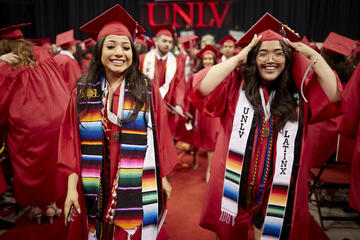
College of Sciences Student Honored at December 2007 Commencement

Zachary Quine, B.S, Physics, was one of six graduates honored for special achievement at the December 2007 commencement ceremonies. Zachary Quine overcame a childhood battle with cancer before finding success in undergraduate research at UNLV. As a student in the department of physics, Zachary performed high-level research with UNLV faculty at Argonne National Laboratory; worked on a laser spectroscopy project at UNLV as part of the NSF-funded and highly competitive Research Experiences for Undergraduates program; and has co-authored at least five peer-reviewed papers, one of which he presented at a multi-university research conference. A promising young physicist, Zachary is currently being recruited by the Los Alamos National Laboratory and the U.S. Army Research Laboratory.

Back to Top


Student Presentation at Biomedical Research Conference

Patricia Sotolongo a junior in the College of Sciences, attended the Annual Biomedical Research Conference for Minority Students (ABRCMS) in Austin, Texas from Nov 7 -10, 2007.  Sotolongo presented a poster session entitled", Colonization of Desert Soil in Pseudomonas fluorescens Strains Affected in Genes that are expressed in a North East Soil."  Previously, Sotolongo received a National Science Foundation (NSF) Research Experience for Undergraduates fellowship, allowing her to work for ten weeks in the laboratory of assistant professor Eduardo Robleto, School of Life Sciences.  

Now in its seventh year, ABRCMS is the largest, professional conference for biomedical students attracting approximately 2,600 individuals, including 1,650 undergraduate students, 280 graduate students, 30 postdoctoral scientists and 750 faculty and administrators. Students come from over 285 U.S. colleges and universities. All are pursuing advanced training in the biomedical sciences, and many have conducted independent research. The conference is designed to encourage underrepresented minority students to pursue advanced training in the biomedical and behavioral sciences and provide faculty mentors and advisors with resources for facilitating students’ success. More than 280 representatives from graduate programs at US colleges and universities as well as scientists from government agencies, foundations, and professional scientific societies join ABRCMS in the exhibitors program to share information about graduate school and summer internship opportunities. These representatives present research opportunities, funding sources, and professional networks. Travel support was provided by the Dean’s Office.

Back to Top


The following students received M.S. or Ph.D. degrees for the Fall 2007 semester.

Department of Chemistry

Emphasis: Chemistry

Sumanvedi Kamatam

Masters in Science, Fall 2007

Thesis Title: "Synthesis and Characterization of Poly(pyridinium salt)s with Oxyalkylene Units Exhibiting Amphotropic Liquid-Crystalline and Photoluminescence Properties"

Emphasis: Biochemistry

James W. Doorman

Masters in Science, Fall 2007

Thesis Title: "Analysis of Iodide and Iodate in Soil and Water"

Swapnaredy Mudiredddi

Masters in Science, Fall 2007

Thesis Title: "Beryllium Inhibits Cellular GSK3B to Activate Signaling Pathways that Lead to Growth Arrest in Cancer Cells"

Department of Geoscience

Joshua Boxell

Masters in Science, Fall 2007

Thesis Title: "Changes in Soil Physical and Hydrological Properties due to the Bromus Tectorum (Cheatgrass) Invasion"

Amy Lynn Brock

Doctorate in Science, Fall 2007

Thesis Title: "Characterization of Stage VI Petrocalcic Horizons:  S. Nevada and N.W. Arizona"

Joseph Kula

Doctorate in Science, Fall 2007

Thesis Title: "Thermochronological Constraints on Mesozoic Tectonism in Southwest U.S. and New Zealand: and 40AR/39AR age Spectra from Artificially Mixed Micas"

School of Life Sciences

Candice Marie Rausch

Masters in Science, Fall 2007

Thesis Title: "The Thermal Ecology of the Red-Spotted Toad, Bufo Punctatus, Across Life History"

Department of Mathematics

Thomas Hodge

Masters in Science, Fall 2007

Thesis Title: "Cryptography in Digital Age"

James Katseanes

Masters in Science, Fall 2007

Thesis Title: "Four Local Coloring of Graphs"

Rina Alfonso Santos

Masters in Science, Fall 2007

Thesis Title: "A Diffusion Model of Lightning Radiative Transfer Using Cylindrical Geometry"

Andrea Wallick

Masters in Science, Fall 2007

Thesis Title: "Suicide by Firearm, Suicide Fatality, and Firearm Availability"

Department of Physics

Wayne K. Ward

Masters in Science, Fall 2007

Thesis Title: "Charge Transfer between N2+ and N2 at Low Energies"

Water Resource Management Program

Alex Baron

Masters in Science, Fall 2007

Thesis Title: "Interaction of Surface and Subsurface Hydrological Processes in the Lower Virgin Valley"


Tracy Marie Boettcher

Masters in Science, Fall 2007

Thesis Title: "The Effect of Erosion Control Structures on the Distribution of Selected
Nutrients and Metals in the Sediments of the Las Vegas Wash"


Jeremy Robert Dodds

Masters in Science, Fall 2007

Thesis Title: "Evapotranspriration Monitoring Methods within an Irrigated Mixed Vegetation Environment"


Back to Top


Balakrishnan Naduvalath, Chemistry Department, has received a National science Foundation Grant, "Hydroxyl and Nitric Oxide Chemistry Relevant to Mesospheric and Lower Thermospheric Energy Budget," ($100,523)

This project will undertake detailed investigations of hydroxyl and nitric oxide chemistry in the upper atmosphere. The reaction between hydrogen atoms and ozone produces OH with up to nine quanta of vibrational excitation. The excited vibrational levels are quenched predominantly by collisions with O and O2. Rate coefficients for quenching of OH vibrational levels v = 1 - 5 by collisions with O atoms and levels v = 1 - 9 by collisions with O2 molecules at temperatures of interest in the mesosphere will be determined using accurate quantum and semiclassical calculations. The resulting database of vibrational relaxation rate coefficients will be made available over the world-wide web. Nitric oxide is the key radiating species in the lower thermosphere and it is produced in highly rotationally and vibrationally excited levels by the reaction between O2 and nitrogen atoms in the ground and electronically excited states. Through quantum scattering calculations on accurate molecular potentials, the proposed work will provide the rate of production of nitric oxide in specific vibrational and rotational levels as functions of the altitude in the thermosphere. Collisional excitation of NO by atomic oxygen and its subsequent deexcitation through collisions with O atoms will also be undertaken using quantum mechanical approaches to quantitatively describe the NO fundamental vibration-rotation band emission at 5.3 - m. The results can be used in models of the energy balance and chemical structure of the upper atmosphere. The broader impacts of the project includes its applicability to a number of middle atmosphere science topics. The research will provide rate coefficients for key reactions in aeronomic models of the mesospheric and lower thermospheric energy budget. As part of the educational component, the project will train a Ph. D. level graduate student and two or three undergraduate students in atmospheric chemistry. Preference will be given to candidates from under-represented communities. The project will also support a postdoctoral scholar who will be responsible for a large portion of the project. 

Back to Top


Pamela Burnley Receives National Science Foundation Grant, "Collaborative Research: CSEDI--Grand Challenge for Experimental Study of Plastic Deformation Under Deep Earth Conditions," ($56,158)

Pamela Burnley, associate research professor, Physics and Astronomy Department, has received a grant from the National Science Foundation (NSF), in the amount of $56,158 for a project entitled, "Collaborative Research: CSEDI--Grand Challenge for Experimental Study of Plastic Deformation Under Deep Earth Conditions."

Abstract: One of the most critical experimental data in developing our understanding of dynamics and evolution of Earth and other terrestrial planets are the data on rheological properties of their constituent materials. The physical and chemical conditions in planetary interior are very broad particularly in terms of pressure. The major challenge in the experimental studies on rheological properties is to develop techniques to obtain quantitative data on rheological under the conditions of planetary interiors. Well-accepted rheological data in the previous studies were limited to those obtained at pressure less than 0.5 GPa. In the previous funding period, the investigators have extended this to ~15 GPa and obtained initial results on rheological properties under the transition zone conditions of Earth''s mantle. However, their studies have also underlined several important challenges: (i) even at relatively low pressures (<10 GPa) there is a large discrepancy in the experimental results (on olivine) among different laboratories, (ii) water fugacity in the previous experiments were not controlled, and (iii) the maximum pressure of quantitative deformation experiments is still limited and virtually nothing quantitative is known about the rheology of the lower mantle of the Earth. The goals of this new phase of the grand challenge project are: (i) to establish a strategy for quantitative deformation experiments under pressures through improved x-ray diffraction and inter-laboratory comparisons, (ii) to develop new methods of controlling water fugacity under high-pressures, and (iii) to expand the pressure (and temperature) range of these studies. The experimental studies will be conducted as a team effort involving experts in this research area across the country. Post-docs and students will be involved in this group effort and the results will be open to the community both through technical reports and through direct collaborations.

The results of this project will provide us with a new tool by which we can determine rheological properties of minerals under a broad range of conditions (under high pressures and controlled water fugacity), and the scientific results that will come out using these techniques will form the basis for geodynamic studies of Earth and planetary interiors.

Back to Top


Adam Simon and Pamela Burnley Receive 2008 Research Infrastructure Award (RIA)

Adam Simon, geoscience department, and Pamela Burnley, geoscience department and physics and astronomy department, received an RIA to acquire an Electron Backscatter Detector (EBSD). There is currently no EBSD facility in the state of Nevada. Establishing an EBSD facility at UNLV will allow faculty in Geosciences, Physics and Astronomy, and Chemistry as well as others on and off campus to conduct cutting edge microtextural and phase identification studies that will enhance ongoing research projects, drive exciting new research, and increase competitiveness for external funding. The added capability will enhance significantly the quality of graduate and undergraduate education as well as EMiL’s ability to attract outside users. An EBSD collects back scattered electrons that have been diffracted by lattice planes within crystalline materials that are being examined in the SEM. The scattered electrons interfere con- and de-structively thus generating a diffraction pattern for each spot that the electron beam hits as it rasters across the sample, revealing information about the orientation and spacing of the crystal lattice planes. Automated analysis of the diffraction patterns allows for rapid phase identification and detailed mapping of grain boundaries, lattice orientations and other microstructural textures at the nanometer scale. EBSD is used in geosciences, materials science, metallurgy and solid state physics, and chemistry on samples ranging from deformed rocks and fossil mollusk shells to thin films and nanomaterials. The EBSD will be available to UNLV faculty and students for their research projects. Currently there are more than 30 students working with faculty members on such projects and the availability of the EBSD detector will allow each of them to add this component into their research. Experience with this cutting edge technique will help students market themselves when they graduate from UNLV.

Back to Top


BIOS Symposium

BIOS is the School of Life Sciences (SoLS) graduate student association and is well named as the word bios is Greek for "life." BIOS is committed to facilitate the professional development of our graduate students and to enhance our academic community. These goals are achieved in numerous ways; BIOS facilitates field specific professional development workshops, funds student travel to scientific meetings, organizes departmental gatherings, presents competitive Excellence Awards for student publications and teaching achievements, hosts invited guest speakers, and organizes the annual BIOS Symposium.

The BIOS Symposium is a daylong event where SoLS graduate students present talks about their research to the department and the greater local scientific community. The Symposium is an honored tradition for Life Sciences graduate students and has existed for over a decade. The 2007 BIOS Symposium was held in the Marjorie Barrick Museum Auditorium on Saturday, November 17th, and 24 students presented talks. These presentations were judged by SoLS faculty members and the top three presenters, Sean Neiswenter (Brett Riddle Lab), Trista Vick (Brian Hedlund Lab), and Jenifer Utz (Frank van Breukelen Lab), were recognized with Excellence Awards.  

Back to Top


Geoscience Undergraduate Receives L. Austin Weeks Grant

Shirley Robinson, a junior geology major in the geoscience department, was selected selected as the L. Austin Weeks Grant Awardee for 2007-2008.  The Weeks Grant is administered by the American Association of Petroleum Geologists (AAPG) in honor of L. Austin Weeks.  Weeks Grants support the educational expenses of undergraduate geoscience students and their departments.  Robinson will receive an award of $500 from AAPG, and the geoscience department will receive an additional $500 to support the educational activities of the local AAPG student chapter. Robinson is the fourth UNLV undergraduate chosen for this honor.


Back to Top


Chemical Interactions Receives Conference Grant

Chemical Interactions, the UNLV American Chemical Society student affiliate group, has received a $2,000 grant to host an undergraduate program for the 2008 ACS 43rd Annual Western Regional Meeting. The program, "Representing the New Faces of Chemistry," will feature a social mixer, a speaker from the ACS Career Services, a talk by UNLV chemistry professor Clemens Heske about current research in the area of renewable energy sources, a poster session featuring research performed by UNLV undergraduate students and secondary teachers in southern Nevada, and an awards luncheon.

The proposed program submitted by UNLV students was determined by ACS officials to "offer the undergraduates in your region a very educational and dynamic experience."

Chemical Interactions prepared a unique proposal, in that the student group has offered to raise $2,000 in funds to match the ACS grant. In addition, the Southern Nevada section of the ACS has the only secondary teacher student affiliate group in the country.  Students at UNLV are planning this event in collaboration with teachers from the Clark County School District and will continue to work with area teachers to plan both the undergraduate and the education positions of the program. The students prepared a program budget that also provides 26 teachers and undergraduate students with registration waivers for the conference.

Congratulations to undergraduate chemistry majors Lacie Brownell and Daniella Sandoval, and the entire membership of Chemical Interactions.


Back to Top


Igor Troitski Donates Laser Optical Equipment

Igor Troitski, a local physicist, has provided the department of physics and astronomy with a second donation of scientific equipment, including a variety of laser optical accessories, including an array of lenses; a solid state laser with neodymium dissolved (LTI-245, energy per pulse is 0.1J); a Beam expander (plano-spherical Galilean telescope; and a 3-D positioner (with electric motor) and software.


Back to Top


College of Sciences Powerpoint Presentation (for high school counselors)

The Undergraduate Advising Center, with assistance from several colleagues through the college, has prepared a powerpoint presentation designed to introduce high school counselors to the teaching, research, and community service activities and programs of the college. This presentation was offered to approximately 100 local high school counselors who visited the UNLV campus on December 11 and 12, 2008.

You can view the powerpoint presentation from links on the "News" section of the College of Sciences homepage, or the "Advising News" section of the College’s Undergraduate Advising Center Home page (http://sciences.unlv.edu/advising/), or at: http://sciences.unlv.edu/advising/pdf/
Counselor-College_Days_2007.ppt

This is intended as a "work in progress" and will be updated regularly with new information and images. 


Back to Top


Physics and Astronomy Forum

On Monday, December 3rd, in BPB 217 Professor Stephane Courteau from Queeen's University (Canada) delivered a talk entitled, "Puzzles in Galaxy Scaling Relations."

Abstract: Spiral galaxies exhibit global correlations between their total luminosity, maximum circular velocity, and disk scale length that pose a fundamental challenge to standard models of structure formation.  On local scales, galaxy scaling relations that include velocity dispersion estimates (such as the M_BH-sigma and the Vcirc-sigma relations) are also challenging to both structure formation and galaxy dynamics models.  I will discuss recent derivations of global and local galaxy scaling relations and our attempts to model them.

On Friday, December 7th, Dr. Yosuke Mizuno (NSSTC/NASA-MSFC) delivered t talk entitled "3D RMHD Simulations of Magnetized Spine-Sheath Lativistic Jets."

Abstract: We have performed numerical simulations of weakly and strongly magnetized relativistic jets embedded in a weakly and strongly magnetized stationary or mildly relativistic (0.5c) sheath flow using the RAISHIN code. In the numerical simulations a jet with Lorentz factor gamma=2.5 is processed to break the initial equilibrium configuration. Results of the numerical simulations are compared to theoretical predictions from a normal mode analysis of the linearized RMHD equations describing a uniform axially magnetized cylindrical relativistic jet embedded in a uniform axially magnetized sheath flow. The prediction of increased stability of a weakly-magnetized system with mildly relativistic sheath flow to Kelvin-Helmholtz instabilities and the stabilization of a strongly-magnetized system with mildly relativistic sheath flow is confirmed by the numerical simulations.

On Thursday, December 13th, Dr. Brant Robertson from the Kavli Institute for Cosmological Physics, University of Chicago delivered a talk entitled, "Merger, Supermassive Black Holes, and the Fundamental Scaling Relations of Simulated Elliptical Galaxies."

Abstract: Elliptical galaxies display an intriguing combination of chaos and regularity.  While these systems likely form in violent mergers of progenitor galaxies, they also obey a variety of striking scaling relations.  Foremost among these relations are the Fundamental Plane, the relation between black hole mass and spheroid mass, and the relation between black hole mass and spheroid velocity dispersion.  We explore the origin and evolution of these relationships that connect the properties of stellar spheroids and the supermassive black holes they host by simulating the formation of spheroidal galaxies in hydrodynamical simulations of disk galaxy mergers.  These simulations demonstrate the crucial role that gas dissipation plays in both forming the spheroidal stellar components as well as feeding supermassive black hole growth.  We also explore the properties of the highest-redshift quasars using hydrodynamical simulations of the hierarchical formation of a quasar host galaxy, and identify new observational methods to explore the formation scenario of billion solar mass supermassive black holes at redshift z~6.

Back to Top


Upcoming Seminars

The College of Sciences has established a listserve to better publicize and promote scientific seminars offered throughout the academic year. For more information on upcoming seminars and to subscribe to the listserve, please visit: http://cmse.unlv.edu/seminar/.

Back to Top


Submit Your News Stories

The College of Sciences E-Newsletter is published on or about the first of each month. Please submit news items via email by the fifteenth of each month, for consideration. You may send your submissions to: Bill Brown, Director of Development william.brown@unlv.edu.

Back to Top


Related Links


Get Adobe Reader